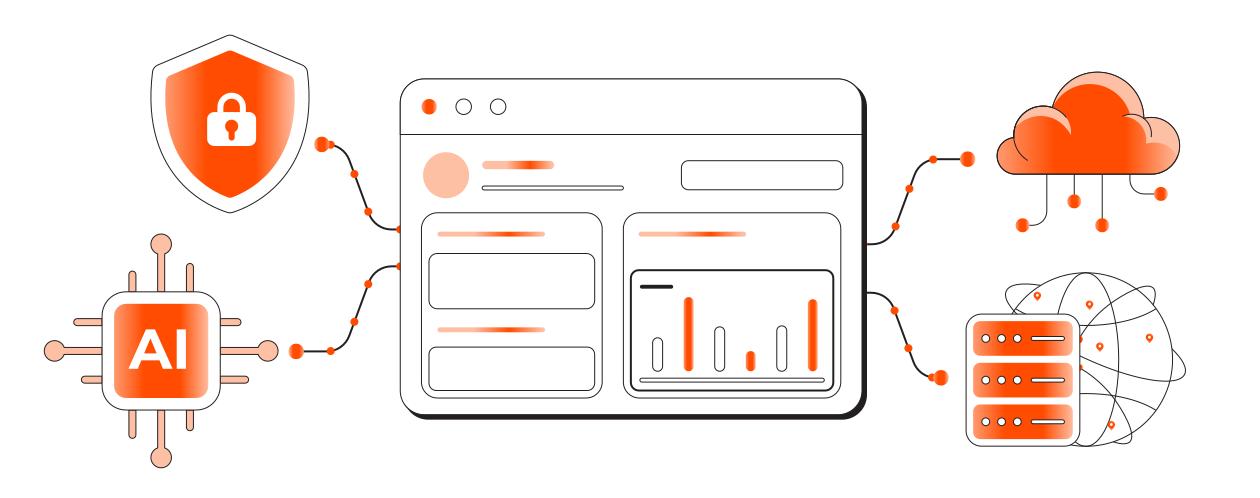



Cloud, Edge, Security and AI Solutions
Gcore accelerates AI training, provides comprehensive cloud services, improves content delivery, and protects servers and applications.
210+
points of presence worldwide
14000+
peering partners
200+
Tbps - total network capacity
30ms
average response time worldwide
Gcore is the foundation for your global infrastructure, applications and business
Protect your website, application, and server against complex DDoS attacks.
Globally Distributed
Our network consists of more than 210 CDN PoPs and 50+ cloud locations.
Secure
Everything we offer seamlessly integrates state of the art DDoS and web protection.
Edge Native
All of our products natively integrate with each other, so your apps always run smoothly at the edge.
Flexible and Scalable
We own our infrastructure, which allows us to tailor our systems to perfectly fit our customers’ needs.
Control, scale and perform. Everywhere you need it.
Our core services:
- Our core services:
Edge Cloud
A ready-made infrastructure for faster development around the world. Our cloud services will not only help you deploy projects at less cost, but also scale as your business grows.
Trusted by thousands of businesses worldwide


Meet our powerful global network
Your networks are at the core of delivering end-user experiences, supporting business initiatives. But often, the performance of your network traffic can be unpredictable due to intermediate networks outside of your control.
200+
Tbps total network capacity
120+
IXPs connected
14,000+
peering partners
Anycast & GeoDNS
network

Gcore named a Leader in 2025 GigaOm Radar for AI Infrastructure
GigaOm’s latest Radar report highlights Gcore’s leadership in platform capability, innovation, and expertise in delivering secure, scalable AI infrastructure. Discover the key findings and see why Gcore stands out as the only European provider ranked as a Leader.
Get the full reportGcore partners
A simple way to control your Cloud
A control panel is integrated with all products: CDN, Streaming, Storage, Cloud, DDoS Protection, and DNS Hosting.

Recent case studiesMore case studies

How Gcore and AVEQ diagnosed live stream stalls for a national broadcaster
Real streaming problems rarely show up with a label on them. The broadcaster's ops team is fielding complaints. A dashboard glows with elevated stall counts. Meanwhile the CDN logs look perfectly healthy — latency is nominal, cache hits are high, nothing's on fire. And the picture still stalls for people at home.That was the setup for one of the more satisfying investigations we've run: a 24/7 channel for a major national broadcaster, with a two-hour DVR window, streamed to millions of viewers. Broadcast-grade — where tolerances are brutal and the margin for error is milliseconds. We found the real problems across four layers and tuned them out one by one, with QoE ground truth from the team at AVEQ and their Surfmeter probes.The one-line version: Some stalls were real. Some were the measurement lying to us. The most interesting one was a timing race no dashboard was built to see. Fixing all three is what broadcast-grade actually means.The challenge: QoS and QoE are not the sameThe terms Quality of Service and Quality of Experience get used interchangeably all the time — which is exactly how you end up staring at a green dashboard while viewers rage-quit. They measure different universes.QoS is the network's story: latency, packet loss, TCP retransmissions, cache hits, response codes. It's objective, it lives in your logs, and — the trap — it's largely independent of what any one person sees on screen.QoE is the viewer's story: does it stall, does it drop to a blurry rendition, how long to first frame. It's measured at the player, not in the pipe. A stream can post gorgeous QoS numbers and still be a miserable watch. Closing that gap is the whole game.In terms of QoE and what users notice, we treat a video freeze of 100 ms or longer as a stall. Anything below that will likely not be perceivable, per AVEQ's research.What "something's wrong" looked likeWhen Gcore was notified of the problem, we collected a list of specific issues:Viewers were seeing visible quality drops and frequent rendition switches mid-playback.Stall counts were running higher than the best-in-class CDNs carrying the same stream under the same conditions.Mean Opinion Score (the viewer quality score, via AVEQ) sliding from a healthy 4.5 to 3.4.One ISP was performing consistently worse than the rest of the pool.The broadcast bar is fewer than five stall events per 24 hours. We were well over it. So — one layer at a time.The approach: triangulating truth across three measurement layersNo single vantage point tells the truth on its own, so we triangulated with three:AVEQ Surfmeter — a client-side QoE app, deployed in several spots, including a probe wired straight to the underperforming ISP. It gave viewer-side metrics — stall counts and stalling time, down-switches, bitrate behavior, MOS — sliced by ISP and player build. CDN logs can't reproduce that.Gcore HAS Probe — our in-house HLS/DASH emulator. It behaves like a player but logs everything: TTFB, time-to-first-frame, manifest and segment timing, and manifest parse errors. It catches what a player hits, but a CDN log shrugs off.CMCD + raw CDN logs — client data emitted by the players, lined up against edge logs so we could tie an infrastructure event to the exact viewer-side impact it caused.Finding 1: giving the busiest path room to breatheThe first finding was in the network. One ISP path caused more degradations than the rest of the pool, and unevenly. At peak, its TCP retransmissions climbed higher than we like. That bites: adaptive streaming has a tight download window, so even a small bump lowers the buffer margin that prevents stalls.The cause was simple capacity distribution: at peak, that path wanted rebalancing across facilities. We redistributed the load, opened headroom on the busiest transit, and let routing settle. Retransmissions tightened to 0.3% — a tenfold improvement — and manifest and segment timing sharpened with it. One QoS number is easy to misfile as a viewer metric: mean delivery duration — server-side processing time, read straight from raw logs, with no client round trip in it. It landed at 23.1 ms, inside the 30 ms target.Finding 2: when the measurement is the bugHere's where it got fun: some of the stalls we were chasing weren't noticeable.Micro-stalls: ghosts in the counter. Running Surfmeter against individual quality profiles, we saw "stall" durations absurdly short — well under the 100 ms bar. These micro-stalls were padding both our counts and the broadcaster's reference stats. To help focus on what matters, AVEQ configured Surfmeter to ignore any stalling below 100 ms, we recomputed every affected test, and the baseline dropped.Player bugs wearing an infrastructure costume. By working together with the broadcaster, we had access to several player versions, including historical ones. Older builds of the broadcaster's reference player were generating false-positive stalls of their own. With AVEQ's data and our CDN log analysis, the player team pinned the trigger. Two releases solved most of the issues — the first alone cut stalls by about 20%.Your player and your measurement tools are part of the quality stack, not neutral observers of it. A CDN investigation that never looks at the player will misattribute problems all day.Because Surfmeter watched the whole multi-CDN setup at once — the same stream through Gcore and the other CDNs, across every player build — we could slice stalling by build and by CDN, separating a player quirk from real CDN behavior instead of guessing. Before the fix, spikes were everywhere, competitors included. After it, Gcore significantly improved its metrics, dropped into the low, flat band and stayed there on every build, while some CDNs kept spiking. Finding 3: a race condition nobody's dashboard could seeThe most interesting find came from HAS Probe's manifest timing — the kind of bug no health dashboard shows.In the broadcaster's case, the stream uses 2-second segments and a big manifest: a two-hour DVR window runs to about 500 KB. Stack a few caching layers in front of that and a timing race appears. The window is tiny — it only opens when a player asks for the manifest a tiny bit before the segment boundary. But across millions of viewers, tiny becomes a steady drip of stalls. Our CDN logs showed manifest-update errors landing exactly on the stalls Surfmeter measured — theory into root cause.The fix: sub-second freshness, no origin changes required. There were two ways out. The clean, structural one is counterintuitive: lengthen the segments, from 2s to 4s — that gives the cache more headroom against the player's polling and makes a stale manifest far less likely. We proposed it, but the origin is shared by every CDN in the pool and running in production, so a segment-length change wasn't something the broadcaster would make for one provider. Fair enough.So, we solved it entirely on our own side, with a Gcore feature we built and proved on this workload: sub-second caching, which revalidates the manifest toward origin at sub-second granularity so the edge always has the freshest segment — no origin changes needed. We validated it on a test resource and can switch it on for the main channels on request. We also resized the shield's hot cache, so the full two-hour DVR window stays warm.The results: measuring what viewers feelWith the fixes in, we needed numbers that track what viewers feel — not just infra health. That's our own CMCD dashboards, estimated straight from Gcore raw logs, video requests only, so audio and subtitles can't skew the ratios:Buffer Starvation Ratio — how often the buffer runs dry and playback stalls.Quality Down-Switch Ratio — how often the player drops to a lower rendition.Low-Resolution Request Ratio — how often it isn't playing the best available rendition.The dashboards caught two clean rollout points: Buffer Starvation stepped from ~0.70% to ~0.50%, then to ~0.37% about a month later — on par with the strongest CDN in the setup.Where delivery landedHere's the final CMCD vector against broadcast-grade targets. Every core indicator came in under threshold, and a controlled multi-CDN comparison — same ISPs, same builds, same window — put Gcore squarely among the best-in-class CDNs on the stream. Most of the field never runs this exercise.MetricTargetGcoreStatusBuffer Starvation Ratio< 0.40%0.37%OptimizedQuality Down-Switch Ratio< 0.30%0.26%OptimizedLow-Resolution Request Ratio< 12.00%10.24%OptimizedMean Client Buffer LengthSustained46.0 sHealthyAnd the metric that started it all: AVEQ's viewer-side MOS climbed from 3.4 back to a stable 4.5 — the performance indicator that first raised the problem was now solved.Key takeawaysA few things that generalize to anyone running live at scale:QoS and QoE need separate instruments. Infra metrics won't surface player bugs, measurement artefacts, or manifest races. You need the player's-eye view.A specialist measurement partner pays off. AVEQ's ISP- and build-segmented data was the difference between guessing and knowing.Manifests are an underrated quality lever. Cache TTL, segment length, and polling interval interact in ways standard dashboards never show.Broadcast-grade quality isn't one well-configured box. It's every layer, tuned together — and proven with measurement you can trust.Live streaming, built for broadcast scaleGcore delivers low-latency live to millions of concurrent viewers, with proactive CMCD monitoring, sub-second caching, and a team that treats "the numbers look fine" as the start of the investigation, not the end.Ground truth from AVEQ SurfmeterAVEQ's Surfmeter measures Quality of Experience from the viewer's side — stall counts, quality switches, bitrate behavior, and MOS, segmented by ISP and player build. It's the layer that told us which stalls were real. Highly recommended for any serious streaming operation.Get in touch to learn more.

Microsoft achieves global-scale content delivery with Gcore CDN
Founded in 1975, Microsoft is a global technology leader renowned for its cloud services, software, and AI innovations. Their portfolio includes widely used products and services such as Azure, Microsoft 365, Windows, and Xbox. With operations spanning the globe and billions of users worldwide, Microsoft requires massive-scale infrastructure to deliver updates, patches, and content reliably to customers across every region. With a commitment to empowering every person and organization on the planet to achieve more, Microsoft continually pushes the boundaries of technology and innovation.Maintaining reliability in a dynamic CDN landscapeIn mid-2024, Microsoft set out to reinforce their multi-CDN strategy. For a company delivering content at Microsoft's scale, maintaining multiple CDN partnerships is essential for global reliability, performance, and the ability to handle increasing delivery demands.As part of this effort to strengthen overall capacity and resilience, Microsoft evaluated and onboarded an additional CDN partner capable of delivering at global scale, integrating seamlessly with their existing multi-CDN architecture, and providing the stability and reliability expected from a delivery partner.A strategic partnership forged through relationship and expertiseTo help maintain a reliable pool of partners for their CDN needs, Microsoft selected Gcore to join an elite group of leading global CDN providers. Working directly with the team in Microsoft's Seattle headquarters, Gcore deployed its global CDN capacity across all major regions, including Europe, North America, LATAM, and APAC, utilizing Gcore's extensive global network with 210+ points of presence to ensure optimal performance wherever Microsoft's users are located.Multi-CDN: Higher availability, better performance, built-in redundancy, and enhanced resilience.The partnership delivered on what matters most: enterprise-grade fundamentals executed at scale. Microsoft's multi-provider strategy requires standardized configurations for operational efficiency, and Gcore demonstrated these critical capabilities:Financial stability: As a financially secure European-based company, Gcore offered the business continuity Microsoft neededGlobal capacity: Ability to deliver massive bandwidth across all major regions worldwideTechnical flexibility: Rapid adaptation to support Microsoft's required features and collaborative approach to integration"Gcore's global infrastructure gave us confidence in their ability to be a long-term partner. Their team demonstrated responsiveness and technical capability throughout the selection process, and their willingness to work directly with our local team showed the kind of partnership approach we value."Joey Etzler, Principal Technical Program Manager – Content Delivery Network, MicrosoftFlexibility and adaptability for seamless integrationThe partnership was designed for progressive scaling, with the technical integration completed efficiently and traffic ramping up smoothly throughout the deployment phase.Gcore demonstrated flexibility throughout the onboarding process, adapting CDN capabilities to support Microsoft's required features while maintaining the standard configuration approach Microsoft employs across all providers. This collaborative relationship enabled smooth integration with Microsoft's existing multi-CDN strategy."The Gcore team was highly responsive throughout our integration process. They quickly adapted to our requirements while maintaining the standardized configuration approach we need across our provider ecosystem, which made the onboarding process smooth and efficient."Joey Etzler, Principal Technical Program Manager – Content Delivery Network, MicrosoftDelivering reliable global performance at scaleWith Gcore's support, Microsoft successfully reinforced their multi-CDN strategy, ensuring resilient, high-performance content delivery to users worldwide. The robust global infrastructure enabled seamless delivery across all regions, maintaining the performance standards that Microsoft's global user base expects.Gcore's performance has matched competitive standards across key metrics, including response time and download speeds, ensuring Microsoft users receive consistent experiences regardless of which CDN provider serves their content."Gcore has consistently delivered the global capacity and reliability we require. Their network has integrated seamlessly into our multi-CDN strategy, meeting our performance standards across all regions."Joey Etzler, Principal Technical Program Manager – Content Delivery Network, MicrosoftBuilding a long-term partnership for the futureBy joining a select group of industry-leading CDN providers, Gcore has proven its ability to deliver enterprise-grade CDN services at a global scale. This partnership showcases Gcore's capability as a European-headquartered company to deliver massive-scale infrastructure for global technology leaders.With the technical integration complete and a proven track record established, Gcore is well-positioned to support Microsoft's evolving global content delivery needs as the relationship matures.Achieving seamless, scalable, and reliable content delivery with GcoreBy leveraging an extensive global network with 210+ points of presence (PoPs) and continuously evolving to deliver cutting-edge infrastructure, Gcore is well-equipped to meet the demands of global technology companies, delivering the capacity, reliability, and global reach that enterprise CDN requirements demand.If you're looking for high-performance, globally-distributed CDN infrastructure that can scale to meet massive capacity requirements, contact us to discuss your content delivery needs.Contact us

Futureproof DDoS defense: dataforest’s partnership with Gcore
Businesses face a challenge: the rise in DDoS attacks using bandwidths of 1 terabit per second (Tbps) and above means they must continuously improve their protection. The latest Gcore Radar Report provides compelling evidence that threats are increasing and attacks are becoming bigger and more frequent every day. dataforest GmbH, which specializes in repelling complex, large-scale DDoS attacks, saw this situation as an opportunity to expand its own capacity.Infrastructure expansion: migrating to modern technologiesIn mid-2023, dataforest began its migration to a new edge-routing concept and upgraded its key transit ports to cutting-edge 400G technology. The company’s partnership with Gcore was decisive in effecting this change. Equipping dataforest with multiple 400 Gbps ports enables it to meet high bandwidth requirements while ensuring the optimum traffic mix, maximum redundancy, and outstanding reliability.We know we can always count on Gcore and see them as a reliable partner. The provision of 400G ports and the excellent cooperation between the two companies’ network departments allow dataforest to continue developing its proprietary zero-loss anti-DDoS solution autonomously. It also means that dataforest can offer customized protection solutions for a wide range of customer needs.– Tim Hochmann, CEO, dataforestInnovation with zero-loss DDoS protectiondataforest uses Gcore’s modern infrastructure to implement innovative zero-loss DDoS protection. This technology gives customers uninterrupted access to their services even under extreme loads. Behind it is a high-performance backbone with a capacity of several Tbps, which provides a stable and reliable foundation for demanding applications.Efficient support: flexibility and fast response timesGcore wins customers over with its technical stability and top-level support, which is characterized by exceptional flexibility and fast response times. In the event of performance losses, networks can often be optimized within just a few minutes using rapid analyses and targeted measures. This agility plays a decisive role in ensuring stability and allowing continuous adaptation to the requirements of dynamic scenarios.Customer focus: specific solutions for dataforestdataforest also saw Gcore’s ability to respond to its specific requirements as key to the collaboration. One example of this is the establishment of a dedicated point of presence (PoP) on the Interxion campus in Frankfurt, Germany. This PoP was built especially for dataforest and fine-tuned to fulfill the company’s particular performance requirements perfectly. Despite the technical complexity, commissioning went smoothly and without any need to compromise on bandwidth, flexibility, or efficiency. “The fact that our edge routing takes place in such a central location on the same campus meant that we could further reduce costs and latencies,” says Tim Lauderbach, who is responsible for the dataforest network. “Our customers therefore benefit from even better and cheaper premium traffic.”Technological synergies: collaborating on BGP FlowspecAnother example of the close collaboration between Gcore and dataforest was the successful implementation of BGP Flowspec. This technology makes it possible to automatically contain volumetric DDoS attacks at network edges within just a few seconds. Thanks to Gcore’s global network of over 180 PoPs, attacks can be limited at the source, creating additional protection for both networks.

How ProSieben scaled Germany’s Next Top Model TOPSHOT for real-time AI portraits with Gcore
To celebrate the 20th season of Germany’s Next Top Model (GNTM), ProSieben’s marketing team launched GNTM TOPSHOT, an AI-powered feature in the Joyn app that instantly transforms user photos into studio-grade, show-inspired portraits.At broadcast scale, the challenge was steep: handle massive primetime spikes, deliver results instantly, and guarantee strict EU privacy compliance. To make it possible, ProSieben turned to Gcore Everywhere AI.“We needed something that could scale on demand, deliver in seconds, and keep data local. Gcore’s infrastructure let us bring a creative idea to life - without breaking the user experience.”- Simon Hawe, Technical Lead, JoynThe challenge: broadcast-scale creativity in real timeTOPSHOT had to satisfy five tough, non-negotiable requirements:Primetime surges. Usage surged before, during, and after live broadcasts across Germany, Austria, and Switzerland.Ultra-low latency. Fans expected results within 5 - 10 seconds per portrait, end-to-end.Privacy by design. Joyn deletes all photos immediately to keep user data truly private - no caching, no storage. Caching wasn’t an option; every request had to be generated fresh.High fidelity. Each portrait required a ~100-stage pipeline for segmentation, relighting, skin/pose preservation, and compositing, to match GNTM’s signature aesthetic.Frictionless UX. No login required. The feature had to “just work,” even on mobile connections.Turning fans into models in real timeProSieben needed an inference platform that was scalable, privacy-compliant, and easy to integrate. Gcore Everywhere AI delivered:One endpoint, nearest node. Smart Routing automatically sent each request to the closest GPU endpoint, minimizing jitter and wait times.Autoscaling GPUs. Serverless orchestration spun GPU capacity up or down in real time, handling unpredictable primetime peaks.EU-ready deployments. Hybrid support (on-prem, Gcore Cloud, public cloud) gave ProSieben full flexibility on data residency.Optimized for image workloads. Everywhere AI ran TOPSHOT’s complex pipelines on NVIDIA H100, A100, and L40S GPUs - excellent for generative image models.“Our biggest challenge was combining visual fidelity with real-time response. Gcore’s Smart Routing and auto-scaling made that possible at primetime scale.”- Benjamin Risom, Chief Product Officer, JoynThe architecture allowed ProSieben to:Route all traffic through a single inference endpoint, fronted by their own load balancerKeep portrait generation under 10 seconds - even during broadcast surgesMeet strict privacy guarantees: no logins, no storage of inputs or outputsDeliver a seamless experience inside the Joyn appTOPSHOT went live with five portrait scenes in April 2025, with three more added weeks later.“We could focus on the creative, knowing the infrastructure would scale with us. That made it possible to deliver something really special for our viewers.”— Sebastian v. Wyschetzki, Creative Lead, Seven.One Entertainment GroupReal-time engagement, broadcast scaleTOPSHOT launched into a season already driving cultural buzz.The GNTM Season 20 finale (June 19, 2025) drew 3.87M viewers with a 22.4% share in the 14 - 49 demo.Joyn saw 10M viewers in April 2025 (+80% YoY) and a 40% increase in watch time in Q1 2025 YoY.TV Total host Sebastian Pufpaff demoed TOPSHOT live on air, praising the visuals and sparking organic uptake.Trade press highlighted the “scalable Gcore infrastructure” behind the feature.“Gcore’s platform gave us regional performance, privacy control, and GPU scaling without the heavy lifting of building and managing infrastructure ourselves.”— Paolo Garri, Infrastructure Architect, JoynWhat’s next?Building on TOPSHOT’s success, ProSieben is playing with new potential fan-facing AI experiences: video portraits, real-time filters, or stylized animations. With Gcore’s flexible infrastructure, the team is free to keep experimenting without re-architecting.“The success of TOPSHOT showed us what’s possible. Now we’re asking: how far can we take this?”— Jutta Meyer, Executive VP Marketing & Creation, Seven.One Entertainment Group
Origin shielding
Prevent the origin from being overloaded during a traffic surge
Free Let’s Encrypt SSL
Issue an SSL certificate for free in order to deliver content over HTTPS
Origin groups
Bind several origins to your CDN
Subscribe
to our newsletter
Get the latest industry trends, exclusive insights, and Gcore updates delivered straight to your inbox.